
The UK’s Energy Crash Report
Britain’s daily energy crash: When it hits and how it shapes what we eat
We’ve all had that point in the day where everything suddenly feels harder than it should.
Maybe you’ve read the same email three times. Maybe you’re making another coffee even though you know it probably won’t fix the problem. Or maybe you’ve opened the snack cupboard because dinner still feels a long way off.
For some people, that dip hits first thing in the morning. For others, it creeps in after lunch. But for many Brits, the daily energy crash has become a normal part of the day, and it can affect more than just productivity.
When we’re tired, food choices can change quickly. A balanced lunch can turn into an afternoon of chocolate, biscuits, caffeine, or skipping food completely and hoping energy somehow comes back on its own.
So when does Britain’s energy really hit its lowest point? And what are we eating when it does?
To find out, Prep Kitchen analysed survey data, UK search trends, national nutrition figures, time-use data and physical activity levels to reveal when Brits crash, what they reach for when energy dips, and why everyday routines can make steady energy harder to maintain.
Most of us know what we should eat when we’re tired. The harder part is actually doing it when you’re busy, hungry, or running on empty. That’s why meal planning helps – it means the easiest choice can still be a balanced one.
The key stats behind Britain’s daily energy crash
- 3pm is the most common time Brits say their energy is lowest, with one in five (20%) choosing this point in the day.
- Brits are most likely to feel at their best mid-morning. 10am is the UK’s most common energy peak.
- Chocolate is Britain’s favourite low-energy snack. More Brits reach for chocolate when their energy dips than any other snack.
- Not everyone turns to sugar when tired. Fresh fruit is the second most common choice, showing a split between quick sweet fixes and more balanced energy snacks.
- Brits are actively searching for energy fixes. There are almost 300,000 UK searches around tiredness, caffeine, sugar crashes, energy foods and afternoon slump-related terms.
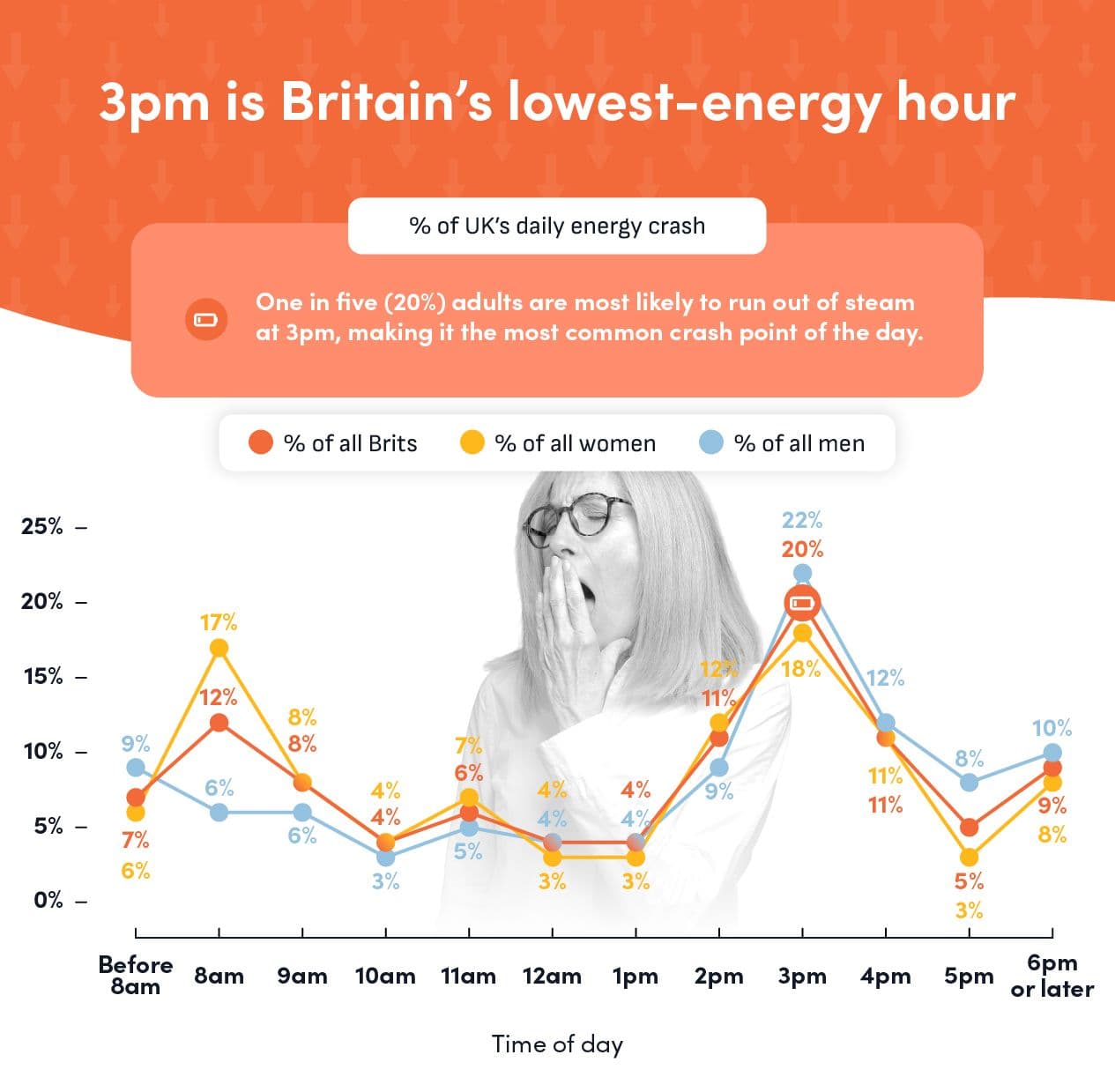
3pm is Britain’s lowest-energy hour
The UK’s daily energy crash hits earlier than many people might expect.
| Rank | Time of Day | % of all Brits | % of women | % of men |
|---|---|---|---|---|
| 1 | 3pm | 20% | 18% | 22% |
| 2 | 8am | 12% | 17% | 6% |
| 3 | 4pm | 11% | 11% | 12% |
| 3 | 2pm | 11% | 12% | 9% |
| 5 | 6pm or later | 9% | 8% | 10% |
| 6 | 9am | 8% | 8% | 6% |
| 7 | Before 8am | 7% | 6% | 9% |
| 8 | 11am | 6% | 7% | 5% |
| 9 | 5pm | 5% | 3% | 8% |
| 10 | 10am | 4% | 4% | 3% |
| 10 | 12pm | 4% | 3% | 4% |
| 10 | 1pm | 4% | 3% | 4% |
While 5pm might feel like the obvious point for an end-of-day slump, the data shows Brits are most likely to run out of steam at 3pm. One in five (20%) adults say this is when their energy is at its lowest, making it the most common crash point of the day.
More than half of Brits say their lowest energy hits after lunch, between 2pm and 6pm or later. So for many people, the slump starts while there is still plenty of the day left to get through.
Why does the afternoon crash happen?
Dan Osman, Performance Nutrition Specialist and Health and Wellbeing Consultant at Prep Kitchen, says:
“The afternoon dip is something a lot of people recognise, and it is not always a sign that you have done anything wrong. Our energy levels naturally shift throughout the day, and many people will feel a drop in alertness in the early to mid-afternoon.
“But food choices can make that dip feel better or worse. If breakfast is rushed, lunch is very light, or the meal is mostly made up of quick-release carbohydrates, like white bread, pastries or sugary snacks, without much protein or fibre, some people may find they feel hungry or tired again quite quickly.
“That is often when people reach for something sweet or another coffee, because it feels like the fastest way to get through the next hour. There’s nothing wrong with enjoying those foods, but if they are the only strategy, they may not give the steadier energy people are looking for.
“A more balanced approach is to think about the whole day rather than one snack. Meals that include a good source of protein, fibre-rich carbohydrates, vegetables and healthy fats are more likely to feel satisfying and help people avoid getting to the point where they are running on empty.”
Women crash earlier, while the 3pm slump gets stronger with age
Britain’s energy crash doesn’t look the same for everyone.
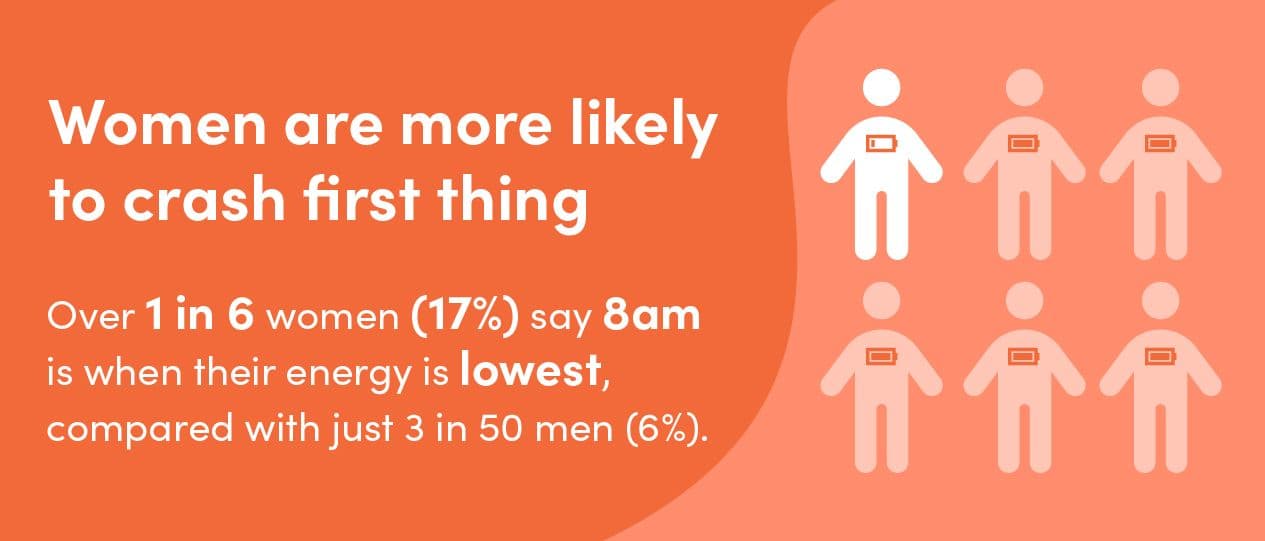
Women are more likely to crash first thing
For women, the day is more likely to start with low energy. Over one in six (17%) say 8am is when their energy is lowest, compared with just 3 in 50 men (6%).
That suggests the morning routine itself may be where some people are already running on empty, before the working day has properly begun.
Paul Mason, Head of Food at Prep Kitchen, says:
“With women in the survey more likely than men to say they crash at 8am, breakfast is an obvious place to look. That does not mean women need a completely different breakfast, but if someone is starting the day already tired, a coffee and something very light may not be enough to carry them through.
“Eating a balanced breakfast within an hour or two of waking also gives the body time to digest and convert food into energy, with many people starting to feel the benefits around 30-60 minutes later.
“A good breakfast should be balanced but realistic, whether that is eggs with wholegrain toast, Greek yoghurt with fruit, or oats with nuts and seeds. Including protein, fibre and slow-release carbohydrates can help provide steadier energy throughout the morning.”
Men are more likely to dip later in the day
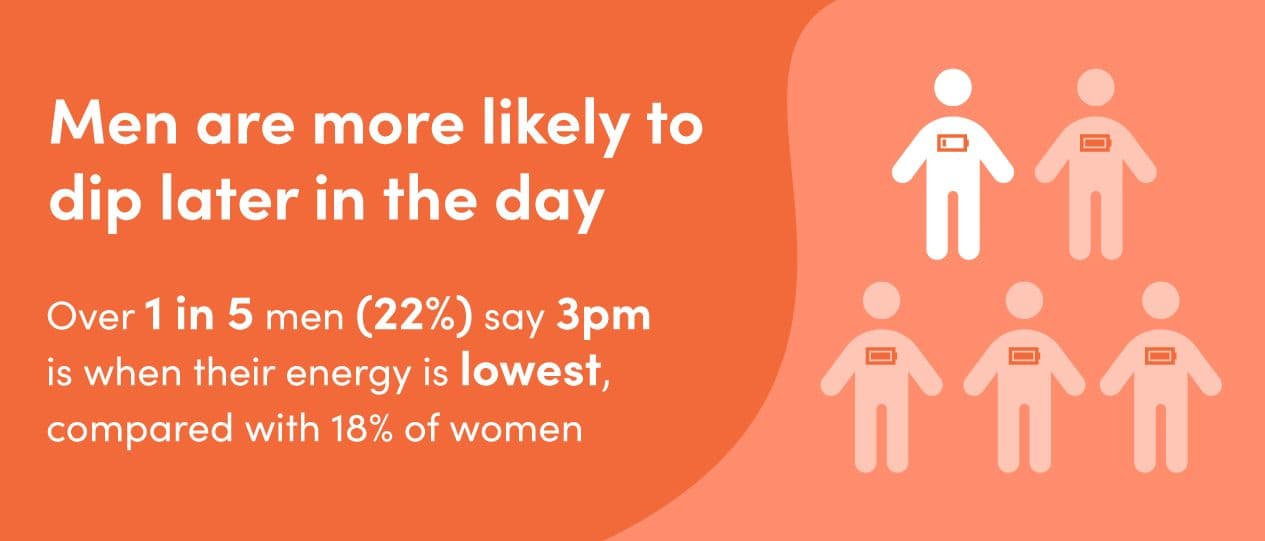
Men, meanwhile, are more likely to feel the afternoon dip. 22% say 3pm is when their energy is lowest, compared with 18% of women. They are also more than twice as likely as women to say their lowest point comes at 5pm, at 8% compared with 3%.
The 3pm slump becomes stronger with age
Age changes the pattern again. The 3pm slump becomes much stronger among older adults, with over a third (34%) of over-65s saying this is when their energy is lowest. Among both 45 to 54-year-olds and 55 to 64-year-olds, the figure is 28%.
Supplements can be useful for some people, but they are not a shortcut for an unbalanced diet. If someone regularly feels unusually tired, it is worth speaking to a GP or registered health professional to check whether anything else is going on, such as low iron, vitamin D or B12 levels.
For day-to-day energy, a balanced lunch, a planned afternoon snack, and a short walk or movement break can be more helpful than waiting until the slump hits and then trying to fix it quickly.
Younger adults are more likely to struggle in the morning
Younger adults are more likely to feel low on energy earlier in the day. Among 25 to 34-year-olds, 8am is the most common crash time, chosen by one in five (20%).
That could point to a different kind of energy problem: not just getting through the afternoon, but starting the day without feeling properly fuelled.
Snack choices change, too
Older adults are more likely to choose fresh fruit when energy dips, while chocolate is stronger among several working-age groups. Among 18- to 24-year-olds, Greek yoghurt and berries stand out more than they do for the population overall.
So while 3pm is the national crash point, the bigger picture is more personal. Some people need help getting through the afternoon. Others need a better start to the day. Either way, the data points to the same issue: food and routine matter most when energy is already low.
How to avoid the afternoon energy crash
Paul shares:
“The biggest mistake people make with the afternoon slump is waiting until they are already exhausted to decide what to eat. By that point, the easiest option is usually going to win.
“That doesn’t mean people need to be perfect, or that they should never have chocolate, biscuits or coffee. It just means it helps to have a plan before energy levels dip.
“Different people need different things from their meals. Someone trying to manage their weight may find that a fat loss meal plan takes the guesswork out of balanced portions, while someone training regularly may need a muscle gain meal plan to help them stay consistent with protein and overall intake.
“Either way, the same principle applies: it is much easier to make a decent choice when the decision has already been made before the slump hits.”
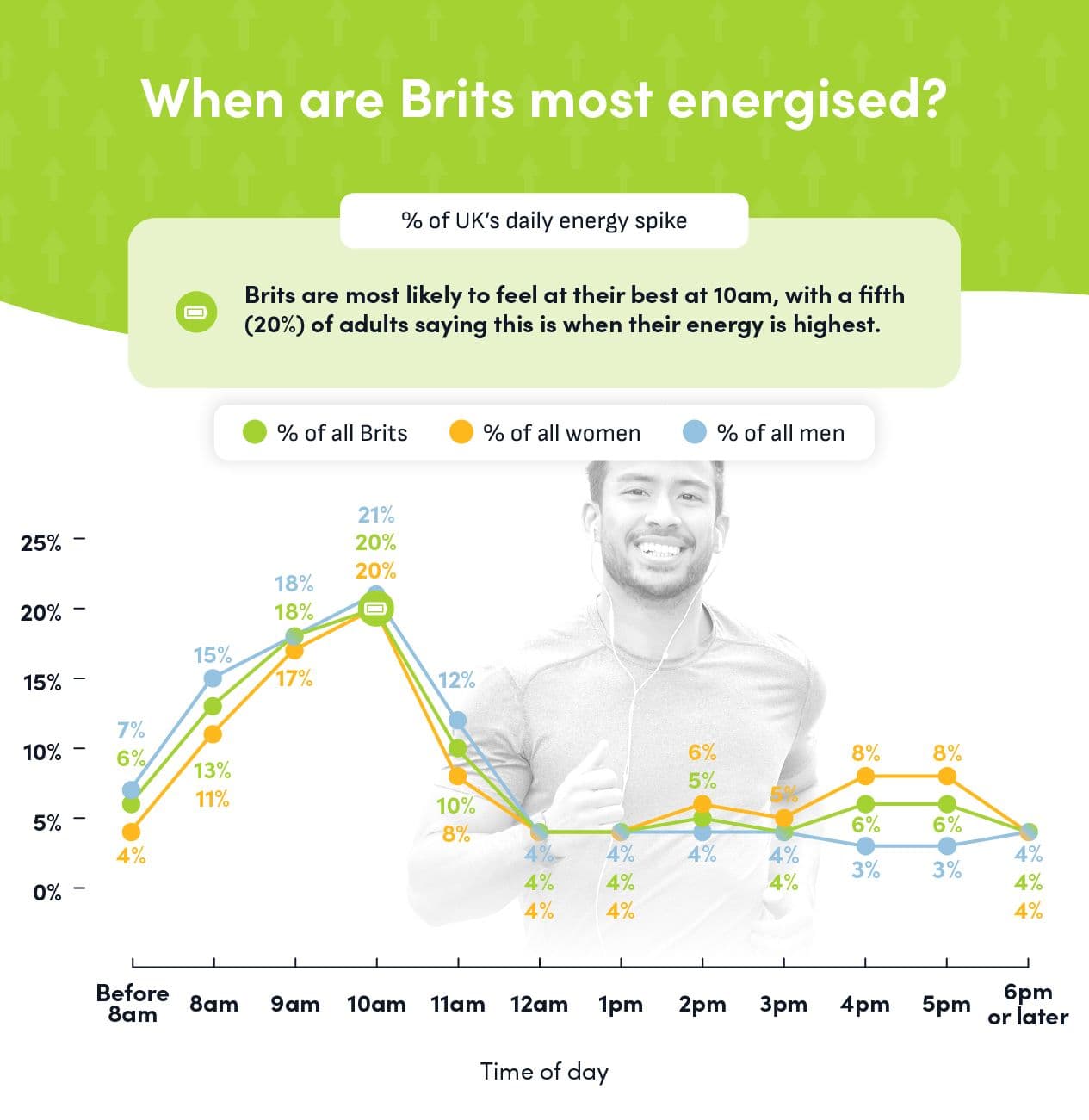
When are Brits most energised?
If 3pm is Britain’s lowest-energy hour, the high point comes much earlier.
| Rank | Time of day | % of Brits | % of women | % of men |
|---|---|---|---|---|
| 1 | 10am | 20% | 20% | 21% |
| 2 | 9am | 18% | 17% | 18% |
| 3 | 8am | 13% | 11% | 15% |
| 4 | 11am | 10% | 8% | 12% |
| 5 | 4pm | 6% | 8% | 3% |
| 5 | 5pm | 6% | 8% | 3% |
| 5 | Before 8am | 6% | 4% | 7% |
| 8 | 2pm | 5% | 6% | 4% |
| 9 | 12pm | 4% | 4% | 4% |
| 9 | 3pm | 4% | 5% | 4% |
| 9 | 1pm | 4% | 4% | 4% |
| 9 | 6pm or later | 4% | 4% | 4% |
Brits are most likely to feel at their best at 10am, with a fifth (20%) of adults saying this is when their energy is highest. The next most common energy peak is 9am, chosen by 18%.
That means many people are getting their best energy before lunch, then carrying on the rest of the day with a declining battery. By the time the afternoon slump hits, there may still be meetings to get through, school runs to do, workouts to fit in, dinner to sort and a whole evening ahead.
Chocolate, fruit or nothing at all: What Brits reach for when energy crashes
When energy drops, people tend to go one of three ways: reach for something sweet, choose a more balanced snack, or skip food altogether.
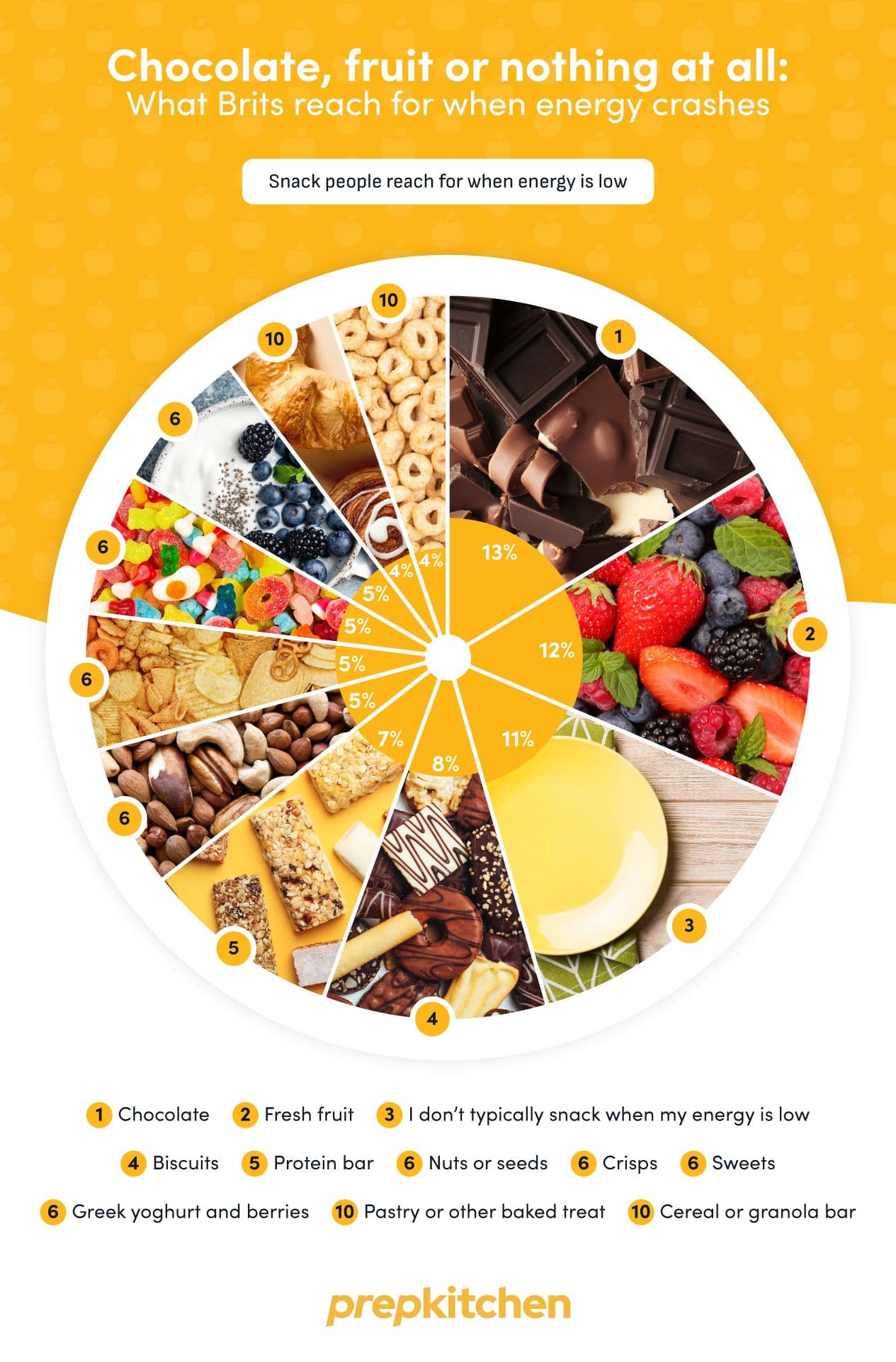
| Rank | Snack people reach for when energy is low | % of Brits | % of women | % of men |
|---|---|---|---|---|
| 1 | Chocolate | 12% | 13% | 14% |
| 2 | Fresh fruit | 12% | 11% | 15% |
| 3 | I don't typically snack when my energy is low | 11% | 10% | 13% |
| 4 | Biscuits | 8% | 7% | 10% |
| 5 | Protein bar | 7% | 6% | 7% |
| 6 | Nuts or seeds | 5% | 6% | 5% |
| 6 | Crisps | 5% | 4% | 7% |
| 6 | Sweets | 5% | 6% | 4% |
| 6 | Greek yoghurt and berries | 5% | 6% | 4% |
| 10 | Pastry or other baked treat | 4% | 4% | 4% |
| 10 | Cereal or granola bar | 4% | 4% | 4% |
Chocolate comes out on top, with one in seven (13%) adults saying it’s what they usually reach for when their energy is low. Fresh fruit is close behind at 12%, suggesting the afternoon slump does not always lead straight to the biscuit tin.
But one of the most interesting findings is how many people choose nothing at all. More than one in 10 (10%) Brits say they do not typically snack when their energy levels are low, making snack skipping the third most common response.
Dan says:
“Some people may not need a snack at all, especially if their meals are balanced and satisfying. But if you are already low on energy and then push through hunger for hours, you may find it harder to concentrate, feel more irritable, or become more likely to reach for the quickest option later.
“That’s because hunger can build in the background. By the time you do eat, you may be more driven by cravings and convenience than by what will actually leave you feeling satisfied.
“If you reach 6pm tired, hungry, and with no plan, the easiest option quickly becomes the most tempting one. Meal prep can take some of that decision-making away, because having healthy meals ready to go means eating well does not depend on how much energy you have left at the end of the day.”
Men are more likely than women to skip snacks when energy is low, with 13% saying they do not typically snack compared with 10% of women. Men are also slightly more likely to choose chocolate, fresh fruit, biscuits, crisps and protein bars, while women are more likely to choose sweets, nuts or seeds, Greek yoghurt and berries.
Brits are searching for energy fixes almost 300,000 times
The search data shows Brits are not just feeling tired. They are trying to work out why.
Across terms linked to tiredness, caffeine, sugar crashes, energy foods and afternoon fatigue, there were almost 300,000 UK searches between June 2025 and May 2026.
The biggest search term in the dataset was ‘tired after eating’, with 33,700 searches. This shows people are not only looking for a quick fix. They are trying to understand what happens to their bodies after meals.
Paul says:
“If you often feel tired after eating, the first thing to look at is the pattern. Is it happening after a very large meal, a meal that is mostly refined carbs, or a lunch that is missing protein and vegetables?
“A useful test is to build your lunch around three things: a clear protein source, a fibre-rich carb, and plenty of veg. For example, turkey with quinoa and roasted peppers, lentil chilli with mixed vegetables, or lean beef with wholegrain couscous and a side salad.
“If that kind of meal leaves you feeling steadier than a very heavy lunch or a quick beige meal, it is a good sign that the issue may be balance rather than food itself. The aim is not to cut things out, but to build meals that keep you satisfied without making the rest of the day feel harder.”
Caffeine is another big theme. ‘How much caffeine is too much’ had 22,800 UK searches, while searches around caffeine crashes, coffee alternatives and energy drinks also appeared in the wider dataset.
| Rank | Search Term | UK searches (June 2024 - May 2026) |
|---|---|---|
| 1 | Tired after eating | 33,700 |
| 2 | How much caffeine is too much | 22,800 |
| 3 | Foods for energy | 21,300 |
| 4 | Sugar crash | 18,300 |
| 5 | Foods that give you energy | 17,480 |
| 6 | How to improve energy levels | 16,380 |
| 7 | How to stop feeling tired | 16,100 |
| 8 | Low sugar snacks | 15,320 |
| 9 | Energy boosting foods | 12,190 |
| 10 | How to get more energy | 10,910 |
What stands out is how many searches come back to food. People are searching for foods for energy, low-sugar snacks and energy-boosting foods, which suggests the public already connects what they eat with how they feel.
But the search behaviour also shows confusion. Are we tired because we need caffeine? Because we have had too much caffeine? Because we have eaten the wrong thing? Because we have not eaten enough?
That uncertainty is exactly why simple, practical advice matters. People do not need another complicated set of rules. They need realistic ways to eat well when the day is busy and energy is low.
The nutrition gap behind Britain’s afternoon slump
National nutrition data adds more context to the story.
Many adults are consuming more free sugars than recommended, while fibre intake remains well below the suggested daily amount. Fibre is often underrated when it comes to energy: it helps meals feel more satisfying, supports gut health, and can make it easier to avoid feeling hungry again soon after eating.
Key national nutrition findings include:
- Free sugars make up around 10% of adults’ daily calorie intake.
- Adults aged 19 to 64 consume around 46.3g of free sugars per day.
- Only 19% of adults meet the free sugars recommendation.
- Average adult fibre intake is 16.4g per day, compared with the recommended 30g per day – around half of what it should be.
- Only 4% of adults meet the fibre recommendation.
Free sugars are most commonly found in foods and drinks such as sugar, preserves and sweet spreads, soft drinks with added sugar, chocolate confectionery, fruit juices and smoothies, cakes, pastries and sweet biscuits.
That doesn’t mean one snack causes the afternoon crash. But it does show that, nationally, many people are not getting the balance of nutrients associated with more sustained energy.
The way we work may not suit the way our bodies need fuel
Part of the problem is that modern routines do not always make steady energy easy.
ONS time-use data shows that adults in employment spend an average of around six hours a day working and travelling combined. That includes around 3 hours and 33 minutes working away from home, 1 hour and 17 minutes working from home, and 1 hour and 16 minutes travelling.
By comparison, the average time spent on exercise, sports, and wellbeing is just 18 minutes a day.
While almost two-thirds of adults are active, around one in four adults is inactive, doing less than 30 minutes of activity per week. That is well below the NHS recommendation of at least 150 minutes of moderate activity, or 75 minutes of vigorous activity, each week.
None of this means people are doing anything wrong. It means the day is often set up in a way that makes the helpful choices harder. Planning meals, taking breaks, moving regularly and eating balanced food all sound simple, but they can be the first things to slip when life is busy.
Methodology
Prep Kitchen is a UK healthy meal prep delivery service built around a simple idea: eating well should feel doable, even when life is busy. Founded by owners Mark Morley and William Fishenden, the brand was created to make balanced, high-protein meals more accessible, without sacrificing flavour.
For this report, Prep Kitchen analysed:
Survey dataA survey of 1,542 UK adults was used to understand when Brits feel their energy levels are highest and lowest, as well as the foods they are most likely to reach for when energy dips.
Time-use dataONS time-use data was analysed to understand how adults in employment spend their day, including time spent working, sleeping, travelling and exercising.
Nutrition dataNational Diet and Nutrition Survey data was analysed to provide context on free sugars, fibre intake and the food groups contributing to adults’ sugar intake.
Physical activity dataSport England Active Lives data was used to understand the proportion of adults who are active, fairly active or inactive.
Search dataGoogle Keyword Planner was used to analyse UK searches around energy, tiredness, caffeine, sugar crashes, energy foods and afternoon slump-related terms.
All data is correct as of June 2026.